

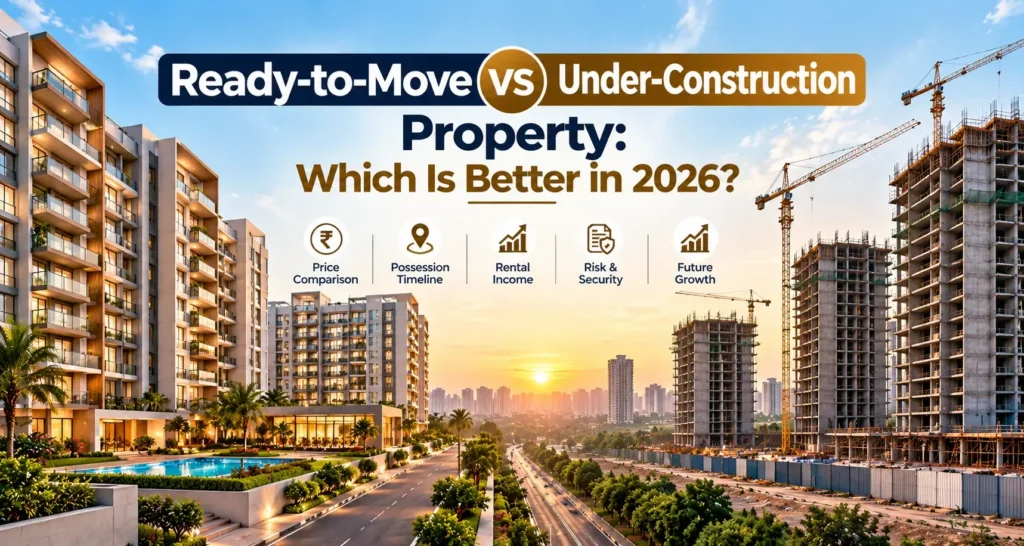
Two colleagues. Same salary. Same savings. One booked a ready-to-move flat and moved in within a month. The other booked an under-construction project promising possession in 2027.
Three years later, the first one had already earned two years of rent. The second one was still paying EMI on an empty apartment.
That’s the whole debate in one sentence.
The Ready-to-Move vs Under-Construction Property question isn’t about which one is “better” in the abstract. It’s about which one fits your timeline, your risk appetite, and your cash flow. This guide breaks down the real trade-offs — price, GST, risk, rental income, and exit liquidity — so you can stop guessing and start deciding.
Table of Contents
- The Core Difference in 2026
- Price and Cost: Where the Gap Really Is
- GST and Tax: The Hidden Swing Factor
- Risk: What You’re Actually Betting On
- Rental Income and Cash Flow
- Home Loan and Financing Differences
- Which One Should You Pick?
- Common Mistakes Buyers Make
- Frequently Asked Questions
- Conclusion
The Core Difference in 2026
Answer-first: “The Ready-to-Move vs Under-Construction Property gap is narrower on price and wider on risk than it’s ever been.” Under-construction properties are still being built, sold at a lower price but with a possession delay risk. In 2026, RERA enforcement and GST changes have narrowed the price gap but widened the risk gap.
Here’s the deal.
A ready-to-move property has already cleared every hurdle — construction, occupancy certificate, and often the builder’s own financial stress. You see what you buy. You get the keys. You start living or renting.
An under-construction property is a promise. A legally binding promise under RERA, yes. But still a promise. The builder has your money, the clock is ticking, and possession can slip.
In 2026, the gap between the two has changed. GST on under-construction homes has been revised, RERA penalties have gotten stricter, and buyers are far more cautious about delivery timelines than they were five years ago. That changes the math.
Quotable: Ready-to-move is certainty. Under-construction is a discount you pay for in patience.
Price and Cost: Where the Gap Really Is
Answer-first: Under-construction properties typically cost 10–20% less than comparable ready-to-move units in the same micro-market. But that discount can be wiped out by rent paid while waiting, EMI paid without possession, and GST. Ready-to-move wins on total cost in most delay scenarios.
Let me paint a picture.
Imagine two 2BHKs, same society, same floor plan. The ready-to-move one is priced at ₹1 crore. The under-construction one in the next tower is priced at ₹85 lakh. That ₹15 lakh gap feels like a no-brainer, right?
Not so fast.
If possession takes 3 years, you’re paying roughly ₹25,000–₹35,000 monthly in rent elsewhere. That’s ₹9–12 lakh gone. Add the EMI you’re paying on the under-construction unit — another ₹60,000+ per month on a ₹85 lakh loan — and the “discount” starts looking very different.
Then there’s the interest paid during construction. On a ₹85 lakh loan at 8.5% for 3 years, you’re shelling out roughly ₹20 lakh in interest before you even get the keys.
Quotable: The under-construction discount is real. So is the rent you pay while you wait.
GST and Tax: The Hidden Swing Factor
Answer-first: Ready-to-move properties with an occupancy certificate are exempt from GST. Under-construction properties attract GST at applicable rates, which adds to the effective cost. For investors, this makes ready-to-move more tax-efficient on day one.
This is where a lot of buyers get caught off guard.
Under-construction properties are treated as a supply of goods and services, so GST applies. Ready-to-move properties that have received their completion certificate or occupancy certificate are treated as completed immovable property — no GST.
That difference alone can be lakhs on a mid-range flat.
For investors specifically, the tax treatment matters even more. On a ready-to-move property, you can start claiming home loan interest deductions immediately if it’s your second property and qualifies. On an under-construction property, deductions typically start only after possession.
Quotable: GST doesn’t care about your budget. It cares about your possession certificate.
Risk: What You’re Actually Betting On
Answer-first: Ready-to-move properties carry low completion risk but higher upfront cost. Under-construction properties carry delivery delay risk, quality risk, and builder financial risk. In 2026, RERA provides legal recourse but does not guarantee on-time possession.
Here’s what usually happens.
A buyer shortlists a project with a 2026 possession date. The brochure is glossy. The sales team is confident. The price is 15% below the ready market. Two years later, the project is 60% complete, the builder is negotiating with lenders, and the possession date has quietly shifted to 2028.
This isn’t rare. It’s a pattern.
With ready-to-move, the risks are mostly known. You inspect the flat, check the society, verify the OC, and you’re done. With under-construction, you’re betting on the builder’s execution ability, financial health, and honesty.
RERA helps. It mandates registration, escrow accounts, and penalties for delays. But RERA is a remedy after the fact, not a prevention. It doesn’t stop a project from stalling.
Quotable: RERA is your safety net. It’s not your insurance.
Rental Income and Cash Flow
Answer-first: Ready-to-move properties start generating rental income within weeks of purchase. Under-construction properties generate zero rental income until possession, which can take 2–5 years. For cash-flow-focused investors, ready-to-move wins decisively.
If your goal is rental yield, this isn’t close.
A ready-to-move flat can be rented out the month you register it. A typical 2BHK in a well-chosen micro-market rents for ₹20,000–₹35,000 monthly depending on the city. Over three years, that’s ₹7–12 lakh of income the under-construction buyer simply doesn’t earn.
And here’s the second-order effect. Rental income helps cover your EMI. It reduces your effective outgo. It makes the loan more manageable. The under-construction buyer gets none of that.
For pure capital appreciation plays, under-construction can still win — but only if the project delivers on time and the micro-market appreciates strongly. That’s a big “if.”
Home Loan and Financing Differences
Answer-first: Home loans for ready-to-move properties are disbursed in full immediately after registration. For under-construction properties, loans are disbursed in tranches tied to construction milestones, meaning you pay interest on amounts released even before possession.
Here’s where it gets technical but matters.
On a ready-to-move property, the bank disburses the full loan amount at once. You start paying EMI on the full amount, but you also have full possession and rental potential.
On an under-construction property, the bank releases funds in stages. You start paying interest on each tranche as it’s released. By the time the project is 80% complete, you may be paying interest on 80% of the loan — without having a home.
This is called pre-EMI interest. It’s a real cost that buyers consistently underestimate. Over a three-year construction period, it can easily add up to ₹15–20 lakh on a mid-range loan.
Quotable: You don’t wait to pay interest on an under-construction home. You pay it the whole time.
Which One Should You Pick?
Answer-first: Pick ready-to-move if you need immediate possession, rental income, or lower risk. Pick under-construction if you have a long horizon, can absorb delays, and want the lowest entry price. For most first-time buyers in 2026, ready-to-move is the safer starting point.
Let’s be honest about the trade-off.
Ready-to-move gives you certainty. You know the layout, the light, the neighbours, the water pressure. You can rent it tomorrow. You can move in next month. The price is higher, but the risk is lower.
Under-construction gives you a discount and potential upside. You’re buying at today’s price for tomorrow’s asset. If the micro-market appreciates 20% by possession, you’ve locked in gains. But if it doesn’t — or if possession slips — you’re stuck.
For most first-time buyers, ready-to-move wins. Simple as that.
For investors with a 5–7 year horizon and the ability to carry costs, under-construction can deliver better returns. But it’s a game for the patient and the well-capitalized.
Common Mistakes Buyers Make
Answer-first: The biggest mistake in the Ready-to-Move vs Under-Construction Property decision is comparing only the sticker price. Buyers ignore GST, pre-EMI interest, rent paid while waiting, and delay risk — all of which can erase the under-construction discount.
Here’s what to watch for:
Trusting the possession date. RERA-registered dates are legally binding, but extensions are common. Always verify the builder’s past delivery record.
Ignoring pre-EMI interest. This is the silent killer of under-construction math. Calculate it before you commit.
Forgetting GST. Under-construction properties attract GST. Ready-to-move with OC do not. On a ₹1 crore property, this is not a rounding error.
Assuming appreciation will bail you out. It might. It might not. Buy the property for what it is, not for what you hope it becomes.
Skipping the OC check. For ready-to-move, verify the occupancy certificate. Without it, you’re effectively buying an under-construction property with a roof.
Frequently Asked Questions
Is ready-to-move better than under-construction in 2026?
It depends on your priorities. Ready-to-move wins on certainty, rental income, and lower risk. Under-construction wins on lower entry price and potential appreciation. In 2026, with stricter RERA enforcement but persistent delays, most first-time buyers are better served by ready-to-move properties in proven micro-markets.
What is the price difference between ready-to-move and under-construction properties?
Under-construction properties typically cost 10–20% less than comparable ready-to-move units in the same micro-market. However, this discount is often offset by GST, pre-EMI interest, and rent paid while waiting for possession. The effective cost difference is usually smaller than the sticker price suggests.
Do I pay GST on under-construction property in 2026?
Yes. Under-construction properties attract GST at applicable rates. Ready-to-move properties that have received their occupancy certificate or completion certificate are exempt from GST. This makes ready-to-move properties significantly more tax-efficient at the point of purchase.
Can I get a home loan for an under-construction property?
Yes, but disbursement happens in tranches tied to construction milestones. You pay pre-EMI interest on each tranche as it’s released, even before you get possession. For ready-to-move properties, the loan is disbursed in full at registration, and you can begin earning rental income immediately.
Is the Ready-to-Move vs Under-Construction Property decision different for investors?
Yes. Investors focused on rental yield should favour ready-to-move properties. Investors with a long horizon and the ability to carry costs can consider under-construction for better entry pricing. The key is matching the property type to your cash flow needs, not just the price tag.
Conclusion
Remember those two colleagues from the start?
The one who bought ready-to-move? She’s been collecting rent for two years. Her EMI is partly covered. Her property has appreciated modestly, but her cash flow is healthy.
The one who bought under-construction? He’s still waiting. Still paying rent. Still paying pre-EMI interest. The possession date has moved twice. The discount he locked in has been quietly eaten by the delay.
Here’s the takeaway. The Ready-to-Move vs Under-Construction Property debate isn’t about which option is universally better. It’s about which one matches your timeline, your cash flow, and your tolerance for uncertainty.
If you want certainty and income, ready-to-move wins.
If you want a discount and can wait, under-construction can work.
But do the full math before you decide. Not just the sticker price. The total cost. The interest. The rent you’re not earning. The risk you’re taking.
Because the property you buy is only half the decision. The other half is what you give up while you wait.
https://www.businessworld.in/article/premium-homes-to-drive-8-11-growth-icra-620966